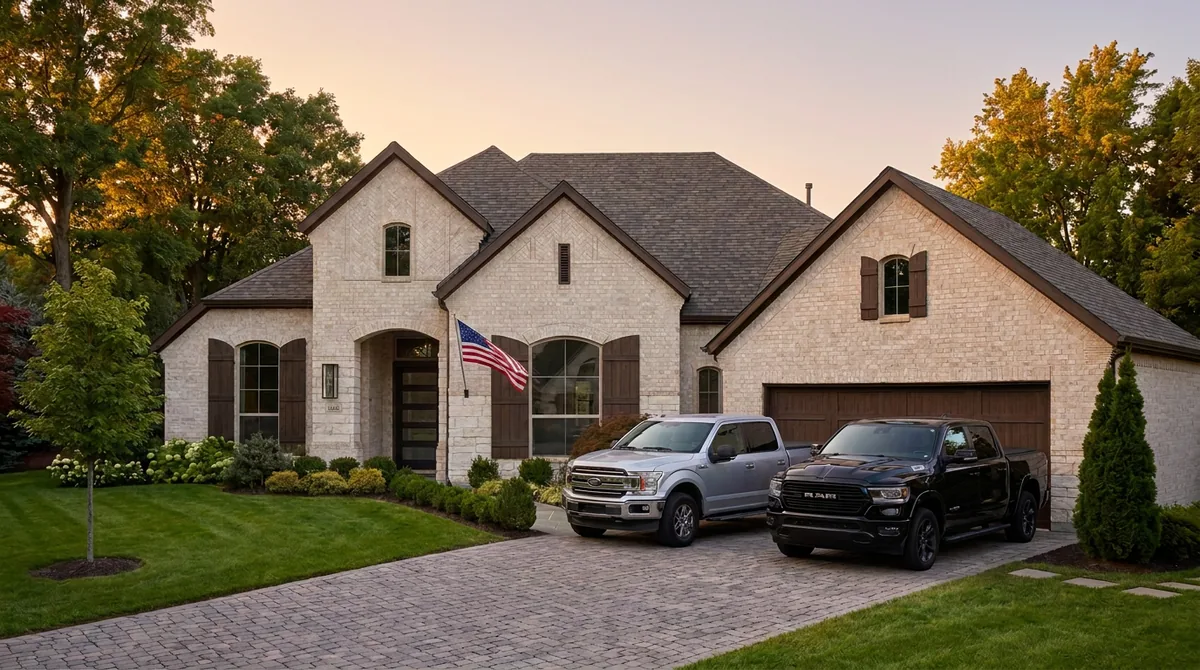
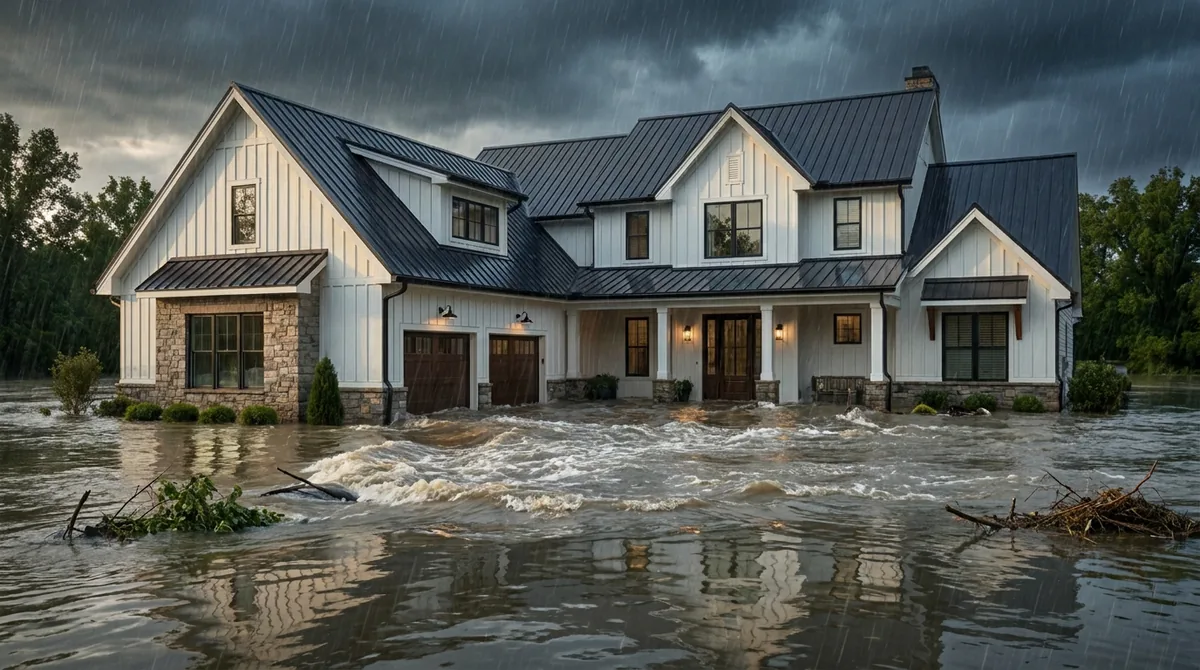
A hailstorm comes through Richardson on a Tuesday in April. Your neighbors' driveways fill with roofing trucks by Thursday. You call your carrier, an adjuster comes out, the roof needs replacing — and then someone says a number to you that you've never heard before, and it's a lot bigger than the $1,000 deductible you thought you had.
That's the wind and hail deductible, and in my experience it is the least-understood line on a Texas homeowners policy. Not because it's complicated — the math is one multiplication — but because almost nobody does that multiplication until an adjuster is standing in the driveway.
I'd rather you do it tonight. This guide is about that one number: what it is, what it's a percentage of, where to find it, why it exists, and what you can actually do about it.
For the wider picture of how a Texas homeowners policy is built — what an HO-3 covers, roof settlement, your non-renewal rights — that's the complete Texas homeowners insurance guide.
What is a wind and hail deductible, and why is it separate?
The short answer: It's a deductible that applies only to wind and hail losses, priced separately from everything else your policy covers — and in most Texas policies today it's expressed as a percentage.
Your homeowners policy doesn't necessarily have one deductible. It commonly has at least two: an all other perils deductible that handles fire, theft, water damage, and most everything else, and a separate wind and hail deductible that handles exactly what its name says.
The all-other-perils deductible is usually a flat dollar figure — $1,000, $2,500, $5,000. That's the number most people remember, because it's the one that sounds like a deductible.
The wind and hail deductible is frequently a percentage instead. And a percentage of a big number produces a big number. That's the whole story of why people are surprised.
Two things are worth saying plainly here. First, a wind/hail deductible is not a penalty and not a sign that something is wrong with your policy — it's standard structure across most of the Texas market now. Second, having one doesn't mean hail isn't covered. Hail is a covered peril on a standard Texas homeowners form. The deductible just determines how much of the loss is yours before the coverage starts paying.
What is the percentage actually a percentage of?
The short answer: Your Coverage A dwelling limit. Not your home's market value, not what you paid for it, and — this is the one that catches people — not the amount of the damage.
If you take one thing from this page, take this. When your declarations page says 2%, that 2% is calculated against Coverage A, the amount your policy insures the structure of your home for. It is not 2% of the claim.
People assume a percentage deductible scales with the damage — that a small claim means a small deductible. It doesn't work that way. The deductible is a fixed dollar amount the moment your policy is issued; the percentage is just how it's expressed. A 2% deductible on a $500,000 dwelling limit is $10,000 whether the hail did $12,000 of damage or $80,000.
Which leads to the uncomfortable arithmetic: on a percentage deductible, smaller hail claims can fall entirely below your deductible and pay nothing at all. Here's what the multiplication looks like across common dwelling limits.
| Coverage A dwelling limit | 1% deductible | 2% deductible | 5% deductible |
|---|---|---|---|
| $250,000 | $2,500 | $5,000 | $12,500 |
| $350,000 | $3,500 | $7,000 | $17,500 |
| $450,000 | $4,500 | $9,000 | $22,500 |
| $600,000 | $6,000 | $12,000 | $30,000 |
| $800,000 | $8,000 | $16,000 | $40,000 |
That table is arithmetic, not a quote — your own limit and percentage are on your declarations page. But find your row, find your column, and that intersection is the number you need to be able to cover on short notice.
How do I find mine on the declarations page?
The short answer: First page of your policy, in the deductibles section — but it's labeled several different ways depending on the carrier, and sometimes it's only shown as a percentage.
Pull up your declarations page. It's the summary page, usually the first thing in the packet, listing your coverages, limits, and deductibles. In the deductible section you're looking for a line that isn't your main deductible. Depending on who wrote the policy it might read:
- Windstorm and Hail Deductible
- Wind/Hail Deductible
- 1% of Coverage A, or 2% of Dwelling, with no dollar figure shown at all
Some carriers do you the courtesy of printing the dollar amount alongside the percentage. Many don't. If yours only shows a percentage, that's the moment to get a calculator out, because the policy is telling you a number without telling you the number.
How does it interact with my regular deductible?
The short answer: They don't stack. One loss triggers one deductible — the wind/hail one if the cause was wind or hail, the all-other-perils one otherwise. What decides it is the cause of the damage, not the room it happened in.
A common worry: if hail breaks the roof and rain comes through and ruins the ceiling, is that two deductibles? Generally no. That's one loss with one proximate cause — the hailstorm — and the interior water damage is part of the same claim. One deductible applies to it.
What decides which deductible applies is what caused the damage. A pipe bursting in February is an all-other-perils loss. A hailstorm in April is a wind/hail loss. Same house, same roof, two different deductibles depending on what happened.
The other question I get constantly: does the deductible reset for each storm? Deductibles generally apply per occurrence, not per year. If you're unlucky enough to be hit by two separate hailstorms in the same spring, you're generally looking at the deductible twice. This is not a well-known feature of Texas homeowners insurance, and in an active hail year it matters a great deal.
Now change one variable. Same storm, same house, but the roof is fourteen years old and the policy settles roofs at actual cash value. Say depreciation reduces the recoverable amount to $16,000. Your $9,000 deductible comes out of that figure — leaving roughly $7,000 toward a $28,000 roof, and about $21,000 for you to find.
Same storm. Same deductible percentage. Wildly different outcome, decided by one other line on the declarations page. Figures are illustrative and chosen to show how the two provisions interact; actual settlements depend on your policy language and the facts of the loss.
Why did carriers move to percentage deductibles?
The short answer: Hail. Texas generates more of it than any other state by a wide margin, roofs cost far more to replace than they used to, and percentage deductibles are one of the main ways the market responded.
I think it helps to understand the mechanism rather than just resenting it, because knowing why it happened tells you where you actually have leverage.
Layer onto that frequency the cost of a roof today. Replacement costs have climbed steeply over the past decade — materials, labor, and the simple fact that after a major storm every crew in North Texas is booked at once, which is its own kind of price pressure.
Carriers facing that math had a few options: raise premiums broadly, stop writing homes in hail-prone areas, tighten roof settlement terms, or shift more of each individual claim onto the policyholder through the deductible. Most of the Texas market did some combination of all four. Percentage deductibles are the fourth lever, and their effect is to move the small and mid-sized hail claims off the policy entirely.
Here's the part that's actually useful to you: because this was a market-wide response rather than a rule, carriers landed in different places. Different percentages, different minimums, different roof settlement terms, different appetites for the same house. That variation is exactly what makes shopping worth doing — and it's genuinely my job to know where those lines currently sit across my markets.
Should I raise my deductible or lower it?
The short answer: Only raise it to a number you could write a check for tomorrow without borrowing. Premium savings are real, but a deductible you can't fund isn't a savings — it's a deferred emergency.
Raising a deductible lowers your premium — the biggest single lever in lowering a Texas home premium — it's the largest lever you directly control on what a Texas home policy costs. That's true, and I'm not going to pretend otherwise. The question is whether the trade is right for your household, and that depends on things a rating algorithm doesn't know about you.
Could you fund it tomorrow?
Not "could you eventually." Could you write that check within a week of a storm, without a credit card or a loan? If not, the deductible is too high regardless of what it saves.
How old is the roof?
An older roof is more likely to need replacing after a storm and more likely to be settled at actual cash value. Both push toward keeping the deductible lower, not higher.
What's the real premium difference?
Get the actual dollar figure for each option rather than assuming. Sometimes the gap between 1% and 2% is meaningful; sometimes it's small enough that the risk isn't worth taking.
Is there a minimum in play?
Some policies express the wind/hail deductible as the greater of a percentage or a stated dollar minimum. If yours does, the percentage isn't the whole answer — read the wording.
Does your mortgage company care?
Escrowed policies sometimes come with lender requirements about deductible structure. Worth confirming before you change anything, not after the change is processed.
How many years of hail have you had?
If your ZIP has been hit repeatedly, the odds of using this deductible are not theoretical. Frequency should push you toward affordability rather than toward the cheapest premium.
What I tell clients: the deductible is the one number on your policy that converts directly into a bill you personally pay. Choose it based on your bank account, and then let the premium be whatever it is. Working the other direction — picking a premium and accepting whatever deductible comes with it — is how people end up with a $16,000 surprise.
Can I reduce what hail costs me without gutting the coverage?
The short answer: Yes — the most durable lever is an impact-resistant roof, and Texas requires carriers to offer a credit for one. But read the terms attached to that credit before you accept it.
This is the honest good news in an otherwise expensive topic. Roof coverings that pass the UL Standard 2218 impact test are classified Class 1 through Class 4, and per the Texas Department of Insurance a Class 4 roof covering receives the highest premium credit. TDI maintains a list of products it has verified as meeting the discount requirements and the UL 2218 test — and TDI is explicit that it doesn't endorse or recommend any particular product.
The practical sequence, if you're replacing a roof anyway:
- Confirm the specific product is UL 2218 Class 4 before installation — by manufacturer and model, not by a contractor's general assurance that the shingles are "impact resistant." Those aren't the same claim.
- Get the documentation at the time of the work. Texas uses a designated impact-resistant roofing installation form for this, and carriers commonly want it along with the manufacturer's certification and an itemized invoice. It's far easier to collect on the day than to chase a roofer six months later.
- Send it to your agent and then verify it landed. Check your next declarations page and confirm the credit is actually reflected. Credits don't apply themselves.
- Tell me the week the roof goes on. A new roof can change your pricing, may qualify for the impact-resistant credit, and can sometimes move you off an actual-cash-value roof schedule back onto replacement cost. That's three separate benefits from one phone call.
What should I do before and after a hailstorm?
The short answer: Before, know your number and photograph your roof. After, document everything, be careful who you sign with, and call before you file rather than after.
Before the season: do the multiplication and know your deductible in dollars. Take dated photos of your roof, gutters, and exterior while everything is intact — that "before" evidence is remarkably useful and almost nobody has it. Confirm whether your roof settles at replacement cost or actual cash value. And make sure your dwelling limit still reflects today's construction costs, because an under-insured dwelling limit is a problem that surfaces at the worst moment.
After a storm: photograph everything before any repairs, including dented gutters, downspouts, window screens, and outdoor units — hail signatures on those are often easier to see than damage on the roof itself. Make temporary repairs to prevent further damage and keep the receipts. Then, before you file, call me.
That last part isn't me drumming up phone calls. Whether to file is a real decision, and it depends on your deductible against the likely scope of damage. If your deductible is $9,000 and the damage is $7,000, filing accomplishes nothing except putting a claim on your record. That's a conversation worth having before the claim, not after — and when I worked the claims side, I saw plenty of people file claims that were never going to pay them anything.
The bottom line
The short answer: Find the percentage, multiply it by your dwelling limit, and decide whether you can live with that number — because in Texas, the odds of using it are not theoretical.
Texas has led the country in major hail events for eleven straight years. The percentage wind and hail deductible is the market's response to that, and it isn't going away. What you control is knowing your number, keeping it inside what you could actually pay, protecting the roof settlement terms that sit alongside it, and taking the impact-resistant credit if a new roof is in your future anyway.
The failure mode I want you to avoid is simple and common: finding out what your deductible is from an adjuster. That conversation goes very differently when you already knew the number and planned around it.
So take two minutes tonight. Find your declarations page, find the wind and hail line, do the multiplication. If the number surprises you — or if you can't find it at all, which happens more than you'd think — send me the page and I'll walk through it with you. I'm here in Richardson, I do this in English and Spanish, and I'd much rather have this conversation in February than in April.
Last reviewed by Jaime Mendez on September 9, 2026. This guide is educational and is not personalized insurance advice — the deductible, roof settlement terms, and endorsements on your own policy govern, and reading them together takes a conversation. Texas insurance law, rates, and carrier appetites change often, and this guide is refreshed quarterly.