Somewhere around 2022, home insurance in Texas stopped being background noise. The renewal letters got loud, the roof paragraph got longer, and phrases like percentage deductible and actual cash value started coming up at kitchen tables all over Richardson. If you've been staring at a bill wondering what exactly you're paying for — and whether you're even covered for the things this part of Texas actually does to houses — this is the whole picture in one place.
Why did Texas home insurance get so expensive?
The short answer: Because Texas weather sends carriers bigger bills than almost anywhere in the country, and rebuilding got dramatically more expensive at the same time. TDI's market data shows the statewide average premium going from $1,961 in 2019 to $3,291 in 2024.
If what you actually want is what a policy costs and what sets your own number, that's how much is homeowners insurance in Texas. If the last few renewal letters felt like a prank, you're not imagining it. The Federal Reserve Bank of Dallas found the median Texas homeowner paid roughly 60% more for home insurance in 2024 than in 2019, well ahead of the national increase. Four things stacked up at once: severe-weather losses led by hail, rebuild-cost inflation on labor and materials, sharply more expensive reinsurance — the coverage insurance companies buy to back their own claims capacity — and rising coverage amounts, because putting a house back together simply costs more than it did.
One more Texas-specific thing worth knowing: this state allows credit-based insurance scoring on home policies. Your credit history is part of your price here, and carriers weight it differently from one another — one of several reasons the identical house draws quotes hundreds of dollars apart. You can't opt out of the scoring. You can make sure somebody is checking which carrier treats your profile best this year.
What does a Texas homeowners policy actually cover?
The short answer: Six coverages doing six different jobs. Most people think of homeowners insurance as one thing that "covers the house." It's really a stack, and the gaps between the layers are where claims go sideways.
The HO-3 is the standard homeowners form in Texas and most everywhere else. Here's what each part does:
Dwelling
The structure itself: walls, roof, floors, built-ins, plumbing, wiring. This is the number that should track rebuild cost — and it's the one most often set wrong.
Other Structures
Detached garage, fence, shed, workshop, pergola. Usually defaults to about 10% of your dwelling limit, which real Texas backyards routinely outgrow.
Personal Property
Everything that would fall out if you turned the house upside down. Typically 50–70% of dwelling. Jewelry, firearms, and collectibles carry sub-limits and often need scheduling.
Loss of Use
Pays your living costs while the house is unlivable after a covered loss — hotel, rental, extra meals. After a bad storm, this is what carries a family for months.
Personal Liability
Protects your savings when someone's hurt on your property or you're responsible for damage — the dog, the trampoline, the guest on a wet patio. Size it to your assets.
Medical Payments
Small, no-fault medical coverage for guests injured at your place. Designed to handle the minor stuff before it ever becomes a liability claim.
Two endorsements I'd want on nearly every North Texas policy, and neither is automatic. Extended replacement cost pays a cushion above your dwelling limit when rebuild costs spike — which is precisely what happens after a regional hail event, when every roofer and framer in the Metroplex is booked at once. Ordinance or law pays to rebuild to current building code rather than the code your house was built under. On a home from the 1960s or 70s — which describes a lot of Richardson — that difference is real money, and without the endorsement it's yours.
How much dwelling coverage do I actually need?
The short answer: Enough to rebuild the house — not what Zillow says it would sell for. Those are different numbers, and confusing them is the most expensive mistake in this entire subject.
Market value includes the lot, the neighborhood, and the school district. Rebuild cost is lumber, labor, roofing, permits, and the crew who shows up. Sometimes rebuild cost is lower than market value; after the last several years of construction inflation, it's frequently higher than people assume. TDI's data shows the average insured dwelling amount in Texas climbing from about $287,900 in 2019 to $408,500 in 2024 — that's the market repricing what it takes to put a house back.
What's this wind and hail deductible everyone keeps mentioning?
The short answer: In most Texas policies, wind and hail claims run through their own deductible — and it's typically a percentage of your dwelling limit, not a flat dollar amount. It's the most misunderstood number on the page.
Here's the math nobody does until an adjuster is standing in the driveway:
There's more to this number than one paragraph can hold — where to find it, how it interacts with your regular deductible, and what you can do about it — so I wrote it up separately in Texas wind and hail deductibles explained. North Texas is why this matters so much. Texas leads the country in hail claims year after year, and the DFW corridor absorbs an outsized share of it — some spring, every few years, the storms line up over the Metroplex and every body shop and roofing crew from Richardson to Fort Worth fills up at once. Carriers price our roofs against that history, and percentage deductibles are one of the main ways they've responded to it.
A note on the coast: policies in the state's designated coastal counties work differently — wind can be excluded and written separately. That's a different market from ours, and if you own property down there it deserves its own conversation. Everything in this guide is written for inland Texas, where I write.
What's the fine print on my roof?
The short answer: Find out whether your roof is covered at replacement cost or actual cash value. That single line decides what your next hail claim actually pays, and it changes quietly at renewal more often than people realize.
I go through this in depth — how depreciation is calculated, why replacement cost arrives as two checks, and how to collect the second one — in the guide to Texas roof replacement and actual cash value coverage. Replacement cost pays what a new roof costs today. Actual cash value pays what your old roof was worth — new-roof price minus years of depreciation. On a fifteen-year-old shingle roof, that difference can turn a $25,000 claim into a check for a fraction of it, and then your percentage deductible comes out of that fraction. More Texas policies have been moving older roofs onto ACV schedules over the past few years. It's rarely announced with a banner; it's a line on your declarations page.
Roof age also drives whether carriers will write your house at all. Many tighten up considerably once a shingle roof passes the fifteen-year mark — fewer offers, ACV-only terms, or higher pricing. That's not cause for panic; it's cause for shopping wider, because different carriers draw those lines in different places and they move them from year to year.
What does a Texas homeowners policy NOT cover?
The short answer: Flood, earth movement (including foundation damage from our clay soil), wear and tear, gradual leaks, and most mold. Two of those are big enough in North Texas to deserve real attention.
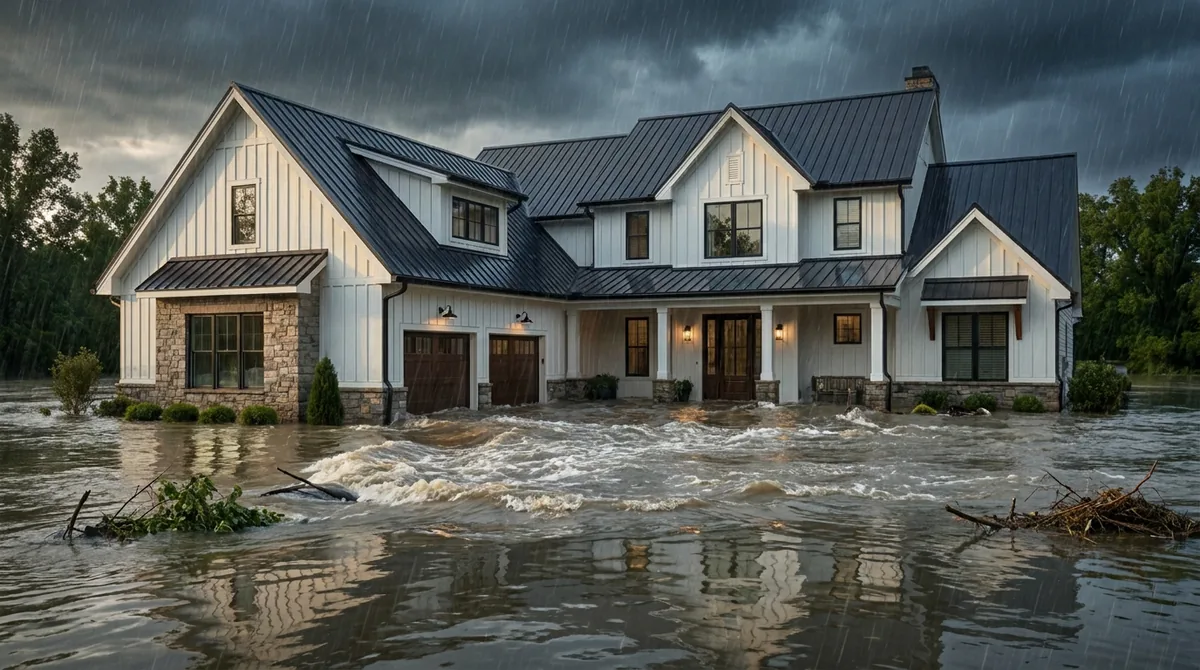
Flood is excluded from every standard homeowners policy. Not partially, not sometimes. Flood coverage is its own policy — through the National Flood Insurance Program or a private flood carrier — and NFIP policies generally carry a 30-day waiting period, so the time to buy is on a sunny day, not when a forecast turns. And "I'm not in a flood zone" describes a map, not where water goes: flash flooding along our creeks and in low-lying pockets of the Metroplex regularly damages homes outside mapped high-risk areas, where coverage also happens to be least expensive. Here's how flood coverage works.
Earth movement is excluded too, and in this part of Texas that mostly means foundation damage from shifting expansive clay soil — the slow cracking that our soil is famous for during drought-and-downpour cycles. Sudden damage from a plumbing leak beneath the slab can be handled differently depending on the policy, which is exactly the kind of detail worth confirming before you need it rather than after.
Also generally not automatic: sewer and drain backup, one of the most common water claims there is. It's usually an inexpensive endorsement, and it's separate from both flood coverage and burst-pipe coverage. Most people learn which one they needed only once the water has already arrived.
Can my insurer drop me — and how much notice do I get?
If you've already received a notice, I wrote a step-by-step guide to what to do after a Texas home insurance non-renewal — the notice periods, the written reason they now owe you, and how to replace the policy in time.
The short answer: Sixty days' written notice, in plain statute. Under Texas Insurance Code §551.105, an insurer must mail notice of non-renewal at least 60 days before your policy expires — and if it misses that deadline, it must renew the policy at your request.
Translated to human: your carrier owes you two months' warning before a non-renewal takes effect. That's not a courtesy, it's your shopping window, and you should use every day of it rather than scrambling in the last week.
The other thing I tell people the day that letter arrives: don't take it personally. Non-renewals in this market are usually a carrier reshaping its book — pulling back in a county, a ZIP range, or a roof-age band — and they say almost nothing about your house specifically. Appetite shifts constantly. A company trimming exposure in Dallas County this year tells you nothing about how the next carrier views your address.
This is also the situation where my setup earns its keep. I'm a Farmers agent, and I can also rate your policy through additional carriers — so when a non-renewal letter shows up, I can take one application and walk it across my markets rather than shrug. Sixty days is plenty of runway when somebody is actually working it for you.
How do I lower my premium without gutting the coverage?
There's a specific order that gets the best result, and I laid the whole sequence out in the order that actually gets a result — including the step almost nobody does, which is checking the change actually landed on your policy.
The short answer: Re-rate annually, stack the credits you've already earned, and tune your deductibles deliberately. Never buy a lower price by shrinking the coverage that exists to rebuild your house.
The honest list, roughly in order of impact:
Re-rate every year
Loyalty doesn't price well in this market. Appetites and rates move annually, and a flattening market rewards whoever actually checks. One conversation, same limits, real numbers.
Bundle
Home with auto is the classic, and renters, condo, umbrella, and life can deepen it. The honest math on bundling is here, and the Texas auto guide covers the other half.
Impact-resistant shingles
In a hail market this is the credit that keeps giving — and documenting a newer roof properly can change both your price and your eligibility. Send me the paperwork the week it's done.
Safety devices
Monitored alarms, water-leak sensors, and updated systems can each earn credits. Cheap to install, and the leak sensor may save you a claim entirely.
Paid-in-full & auto-pay
Small percentages that cost nothing but a calendar reminder, and they stack with everything else here.
Tune, don't gut
Raising your flat all-peril deductible lowers premium — but only take an amount you could genuinely write a check for. Same logic, harder math, on the wind/hail percentage.
The bottom line
The short answer: Know your wind and hail deductible in dollars, check whether your roof settles at replacement cost, keep your dwelling limit current, and have someone re-shop it every year.
Texas home insurance got expensive because Texas weather got expensive — but the market has caught its breath, and a flat market rewards the people who actually shop it. Set the dwelling limit to rebuild cost. Multiply out your hail deductible tonight. Find out whether your roof is RCV or ACV. Close the flood gap while it's cheap. Know your 60-day rights. And make somebody re-rate the whole thing once a year.
That somebody can be me. Bring me your declarations page — or just your ZIP and fifteen minutes — and I'll read it the way I learned to on the claims side, tell you exactly where the holes are, and price it across my markets. In English or Spanish, and there's a $10 e-gift card in it just for letting me prepare the quote.
Last reviewed by Jaime Mendez on September 9, 2026. This guide is educational and is not personalized insurance advice — coverage that fits your home takes a conversation. Texas insurance law, rates, and carrier appetites change often, and this guide is refreshed quarterly.