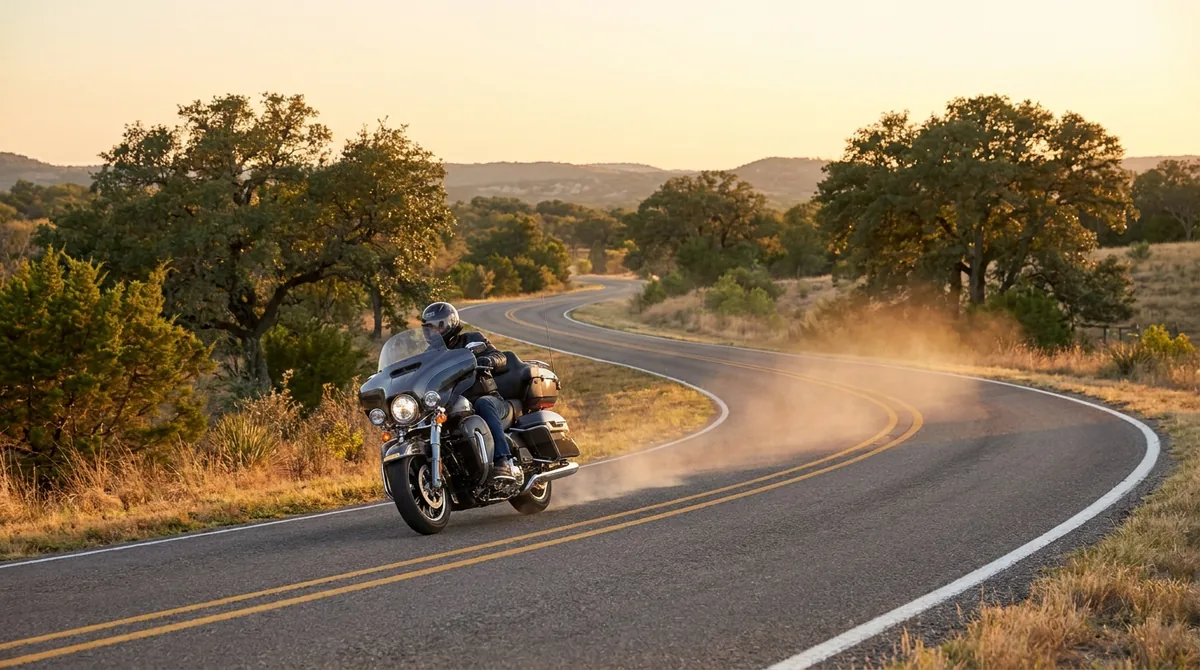
A motorcycle on a Texas highway
Home / Motorcycle Insurance

Texas Motorcycle Insurance: Twelve months of season. Zero margin for bare.

Texas rides year-round — North Texas backroads in January, Hill Country in April. It also shares the road with one in seven drivers carrying nothing at all. Build the policy for both.

30/60/25
TX Minimum Liability
1 in 7
TX Drivers Uninsured
21+
Helmet Optional, With Strings
15 min
To a Real Quote
The Quick Answer

A Texas motorcycle needs its own 30/60/25 liability policy; your auto policy does not cover it. The coverage that matters most here is uninsured/underinsured motorist — roughly one in seven Texas drivers carries nothing, and on a bike you have no steel around you. Insurers must offer UM/UIM and PIP, and declining either takes a written rejection we almost never recommend signing. Two rules riders ask about: lane splitting is not legal in Texas — it is ticketable and hands the other side a fault argument — and the helmet is mandatory under 21, optional at 21+ only with an approved safety course or qualifying health coverage. Round out the policy with custom parts coverage (defaults are tiny), safety apparel for the four-figure kit, and guest passenger liability if anyone ever rides behind you. The season runs twelve months, so should the policy. Jaime Mendez Insurance in Texas quotes riders free at (214) 295-5628.

Required
30/60/25, on its own policy
Most important add
UM/UIM — 1 in 7 ride against nothing
Lane splitting
Not legal in Texas
Free quotes
(214) 295-5628
Texas Motorcycle Insurance, The Short Version

Texas gives riders a twelve-month season. And one in seven reasons to armor the policy.

Start with what makes riding here good: the season never really closes. January backroads out past Denton, spring runs up to Lake Texoma, long weekends chasing Hill Country sweepers. More months on the road means more miles, and more miles mean the policy is not a formality — it is equipment, as real as the helmet.

Now the part that shapes every recommendation on this page. Roughly one in seven Texas drivers carries no insurance at all, and plenty more carry the bare 30/60/25 minimum. In a car, that is an annoyance. On a bike, you are the crumple zone, and the driver who turned left in front of you being uninsured turns a bad day into a financial one. That is why uninsured/underinsured motorist coverage is the first thing we size on a rider policy, matched to real limits, with the written-rejection form left unsigned.

Texas also runs its rider rules differently than the coasts. Lane splitting is not legal here — however tempting stopped I-45 traffic looks — and doing it before a crash costs you twice: the ticket, and a fault argument against your recovery. The helmet is mandatory under 21; at 21 and over, Texas lets you ride without one only if you have completed an approved safety course or carry qualifying health coverage — and either way, the helmet quietly protects your injury claim as well as your head.

The rest is making the policy match the bike you actually ride: custom parts coverage above the tiny default, safety apparel for the gear, guest passenger liability if anyone rides with you, and comprehensive against the two Texas constants — theft and hail. One call, bundled with the car and the house, and it is usually cheaper than riders expect.
What a rider policy needs. And the three gaps nobody mentions.

The required part is small. The parts that decide whether a bad day ruins you are all optional.

Required by law
30/60/25

Liability

The same 30/60/25 Texas requires of a car, on the bike's own policy. Covers what you do to others' bodies and property, plus defense. On a vehicle this exposed, we treat the minimum as the floor for the conversation, not the recommendation.

Do not decline
UM / UIM

Uninsured Motorist

Must be offered, and you can only refuse it in writing. Roughly one in seven Texas drivers has nothing, and on a bike you have no steel around you. This is the coverage that pays when the guy who turned left in front of you cannot.

Strongly recommended
Med Pay

Medical Payments

Liability pays the other person. This pays you, regardless of fault, and it lands before your health plan deductible does. Inexpensive, and on two wheels even a modest get-off means an ambulance.

If you'd miss it
Comp & Collision

Physical Damage

Repairs or replaces the bike. Comprehensive matters more than riders think: Texas runs near the top of national motorcycle-theft rankings, and it leads the country in major hailstorms. Your garage is not coverage, and your carport definitely is not.

Off-season
Lay-Up

Lay-Up / Seasonal

The right answer instead of cancelling when you park it for the season. Keeps comprehensive alive against theft while suspending what you are not using. Cancelling creates a coverage gap that raises what you pay later.

Free money
CMSP

Safety Course Discount

An approved motorcycle safety course earns a discount with most carriers, is part of getting your Class M license, and unlocks the 21-and-over helmet exemption. Safer, faster to license, cheaper to insure. Take it.

Usually a gap
Your Mods

Custom Parts & Equipment

Standard policies assume a stock bike and cap accessories at a small default. Exhaust, bars, bags, seat, paint, lighting, engine work. Add up what you have spent past stock, then raise the limit to match. It is cheap.

Usually a gap
Your Gear

Safety Apparel

Helmet, jacket, gloves, boots, armor. It is not part of the bike, so the bike's coverage does not replace it. A full kit runs into four figures and one get-off destroys all of it at once, in the same crash that bent the frame.

Check this
Passengers

Guest Passenger Liability

Some rider policies limit or exclude passenger liability, or make it an add-on. The person on the back is the most likely to be badly hurt in your crash. If you ever carry anyone, this line is not optional.

Is your bike insured as the bike you actually built?

Mods, gear, and the passenger line are the three we find wrong most often. Send us your declarations page and we will read it with you, free.

The Texas Rules That Matter

Four things that change how a claim goes here.

Texas treats riders differently than the coasts — looser in some ways, and less forgiving in the ones that decide what a claim pays.

1. One in seven, and you're the crumple zone

Texas has no special statute punishing uninsured riders' recoveries — it does not need one to make riding bare a terrible idea. With roughly one in seven drivers uninsured and many more at minimum limits, the practical rule is simple: the coverage most likely to pay for your hospital stay is your own UM/UIM, stacked with PIP and your health insurance. Size that stack like your femur depends on it.

2. Lane splitting is not legal here

Texas law does not authorize splitting or filtering; riding between lanes is ticketable. The insurance angle is what makes it expensive: Texas runs modified comparative negligence with a 51 percent bar, so splitting before a crash hands the other side a ready-made fault argument — and if they push you past 50 percent, your recovery is zero. Legislators keep filing filtering bills; until one passes, stay in the lane.

3. The helmet is a legal issue twice

Under 21: DOT-compliant helmet, every ride, no exceptions. At 21 and over, Texas allows riding without one only if you have completed an approved motorcycle operator training course or carry qualifying health coverage. Then the second issue: after a crash involving head injuries, the missing helmet has a way of showing up in the argument over what you recover. The exemption is real. So is the trade.

4. Your auto policy is not helping

A motorcycle is never covered by your car's policy; it needs its own. The upside of doing it properly: bikes rate cheaper than people expect, and bundling the bike with the auto and home policies usually pays for a chunk of it. One call, one team, the whole garage.

Let it lapse at some point? Get it back in force today.

A gap raises your rate, exposes the bike to theft and hail while parked, and leaves you bare against the one-in-seven. One call fixes it.

Whatever you ride. However you ride it.

A commuter splitting down 101 and a garage-queen restoration are not the same policy. Tell us which one you are.

One call, and it's usually cheaper than you think.

You ride fewer miles than you drive, and it bundles with the car and the house. Tell us about the bike and we will quote it properly.

Motorcycle insurance in Richardson. And across all of Texas.

Where you park it matters as much as where you ride it. Theft rates and premiums both move ZIP by ZIP.

Texas rider questions. Straight answers.

Is motorcycle insurance required in Texas?

Yes. A motorcycle is a motor vehicle, so it needs the same 30/60/25 liability Texas requires of a car: $30,000 per injured person, $60,000 per accident, and $25,000 in property damage.

Insurers must offer PIP and uninsured/underinsured motorist coverage, and declining either requires written rejection. On a bike, we almost never recommend rejecting UM/UIM.

Does my auto policy cover my motorcycle?

No.

A motorcycle needs its own policy; your auto policy does not extend to it. The good news is that bike policies are usually cheaper than people expect — you ride fewer miles than you drive — and bundling the bike with your auto and home trims the whole stack.

What happens if an uninsured driver hits me?

This is the rider question in Texas, because roughly one in seven drivers carries no insurance and on a bike you are the crumple zone.

Uninsured/underinsured motorist coverage steps into the at-fault driver's shoes and pays for your injuries, and UM property damage covers the bike. It is the single most important optional coverage on a Texas rider policy.

Is lane splitting legal in Texas?

No.

Texas law does not authorize lane splitting or filtering; riding between lanes can be ticketed, and doing it before a crash gives the other side a fault argument under Texas's modified comparative negligence system, where being found 51 percent or more at fault bars recovery. However tempting stopped traffic on I-45 looks, splitting costs you legally twice.

Do I have to wear a helmet in Texas?

Under 21: yes, DOT-compliant, no exceptions. At 21 and over, Texas allows riding without a helmet only if you have completed an approved motorcycle operator training course or carry qualifying health insurance coverage.

There is a second, quieter issue: after a crash, not wearing a helmet can be raised when head injuries are involved. The helmet protects your head and your claim.

Does liability coverage pay for my own injuries?

No. Liability pays for the people you injure and the property you damage.

Your own injuries are covered by PIP or medical payments, your health insurance, and — when the other driver is at fault and uninsured or underinsured — your UM/UIM coverage. On a bike, building that injury stack deliberately matters more than on any car.

Are my custom parts and accessories covered?

Only up to a small default limit — often around $3,000 — and Texas bikes wear real money: pipes, bars, seats, luggage, chrome, paint.

Custom parts and equipment coverage raises that limit to match reality, and it is cheap. Bring us the receipts, or at least an honest list, and we will size it properly.

Is my riding gear covered?

Not automatically. Your helmet, jacket, gloves, boots, and armor are not part of the motorcycle, so the bike's physical damage coverage does not replace them.

A full kit runs into four figures and one get-off destroys all of it at once. Safety apparel coverage exists for exactly this, and it costs little.

Is my passenger covered?

Check, do not assume. Guest passenger liability covers the person on the back — the one most likely to be seriously hurt in your crash and whose family is most likely to file the claim.

Some policies include it, some do not. If you ever carry anyone, make sure yours does.

Can I drop coverage in the off-season?

What off-season? Texas rides twelve months, which is exactly why lapsing is a bad trade here: a parked bike still gets stolen or hammered by hail — both comprehensive claims — and a coverage gap raises what you pay when you restart.

If the bike truly hibernates, a lay-up arrangement suspends what you are not using while keeping comprehensive alive. Cancelling outright saves less than you think.

Will a safety course lower my rate?

Yes, three ways. An approved motorcycle safety course earns a discount with most carriers, it is part of getting your Class M license, and for riders 21 and over it is one of the two paths to Texas's helmet exemption.

Safer, faster to license, cheaper to insure. Take it.

Do scooters and mopeds need insurance too?

If it is registered for the road, it needs liability coverage, and small displacement does not shrink the liability: a 150cc scooter can put a pedestrian in the hospital as effectively as a liter bike.

Coverage for scooters is inexpensive. Tell us what you ride and we will place it correctly.

Still have questions? Call (214) 295-5628. We will give you a straight answer.

Ride it. Don't worry about it.
Free, fast, and in plain English.

Tell us what you ride, what you have done to it, and who rides with you. We will build the policy around the actual bike and quote it in about 15 minutes.