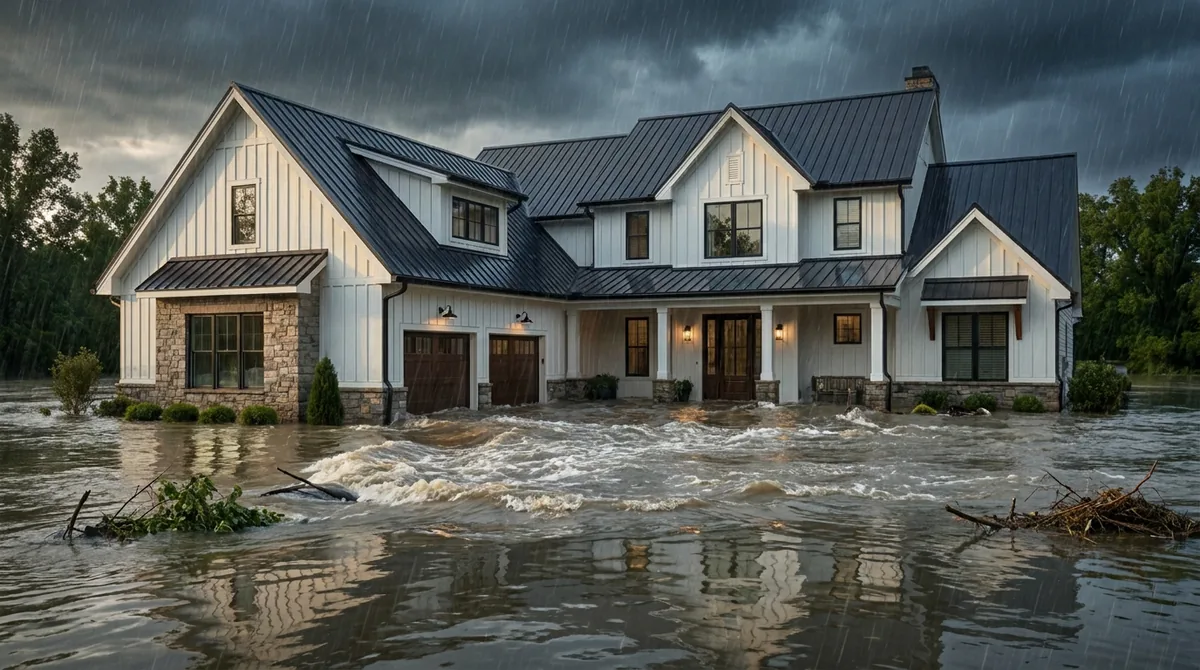
Floodwater rising near a Texas home
Home / Flood Insurance

Texas Flood Insurance: The policy Texas is actually about.

Your homeowners policy will never pay a flood claim. Not one dollar. We quote NFIP and private flood side by side, anywhere in Texas — inland flash flooding and coastal surge alike.

$0
Flood Coverage In A Home Policy
56%
Harris Co. Claims Outside High-Risk Zones
30 Days
NFIP Waiting Period
15 min
To a Real Quote
The Quick Answer

Homeowners insurance never covers flood. Rising water, storm surge, and creek or bayou overflow require a separate policy through the National Flood Insurance Program (NFIP) or a private flood carrier. NFIP limits are $250,000 for the building and $100,000 for contents, with a 30-day waiting period unless the policy is bought at a loan closing. Flood insurance is only mandatory in high-risk zones with a federally backed mortgage, but roughly 56 percent of Harris County flood claims have come from outside high-risk zones, and about 80 percent of the homes Hurricane Harvey flooded here carried no flood coverage. Pricing is property-specific under Risk Rating 2.0, and Harris County's flood maps are being updated in 2026, which makes this the year to lock coverage in. Jaime Mendez Insurance in Texas quotes NFIP and private flood side by side for free at (214) 295-5628.

Home policy pays
$0 for flood, always
NFIP limits
$250k building / $100k contents
Waiting period
30 days (none at loan closing)
Free quotes
(214) 295-5628
Texas Flood Insurance, The Short Version

The most important policy most Texas homes don't have. Yet.

Here is the sentence that surprises almost everyone, so we will put it first: your homeowners policy pays nothing for flood damage. Not a reduced amount. Nothing. Rising water, storm surge, and overflow from creeks, bayous, and drainage are excluded from every standard home policy in Texas, and the exclusion does not care how good your carrier is or how long you have been a customer. Flood coverage is its own policy, through the federal NFIP or a private flood carrier, and this area is precisely who it was invented for.

The second surprise is who floods. The mandate map and the risk map are two different maps. Lenders only require flood insurance in high-risk zones, but roughly 56 percent of Harris County's flood claims have come from outside those zones, and when Harvey put neighborhoods underwater from Texas to Kingwood, about 80 percent of the flooded homes had no flood coverage at all. Anyone who watched Clear Creek that week does not need the statistic explained.

The third thing to know is that this market has genuinely changed. FEMA now prices every property individually under Risk Rating 2.0, private flood carriers compete for Texas business with higher limits and better contents coverage, and Harris County's flood maps are being redrawn in 2026, which will pull many properties into mandatory-purchase territory. Buying while your address is still mapped lower-risk is one of the few timing plays in insurance that actually works.

That is the entire offer here. We will pull your flood zone, quote NFIP and private side by side, size the building and contents limits to your actual house, and show you how the flood policy fits the stack next to your home policy and, on the coast, the wind policy. A flooded car, by the way, is an auto policy matter — one more reason the whole plan belongs with one team. Call (214) 295-5628 and we will do it in about 15 minutes.

What a flood policy covers. And the three things it never does.

A flood policy is simpler than a homeowners policy — two main coverages plus a code-upgrade helper — but its limits, definitions, and gaps are exactly where claims go sideways. Here is the map.

Building
Up to $250k NFIP

Building Property

The structure itself: foundation, walls, electrical and plumbing systems, furnace and water heater, built-in appliances, and attached fixtures. The NFIP caps this at $250,000; if your home would cost more to rebuild, a private or excess flood policy closes the gap above the cap.

Contents
Up to $100k NFIP

Personal Property

Furniture, clothing, electronics, and the rest of what you own, on its own limit and deductible. The catch: the NFIP pays contents at actual cash value — depreciated worth, not replacement price. Private flood policies often pay replacement cost, which is one of their strongest selling points.

ICC
Up to $30k

Increased Cost of Compliance

If a flood leaves your home substantially damaged, the city can require you to rebuild to current floodplain code — elevated, floodproofed, or relocated. ICC adds up to $30,000 toward exactly those costs, and along Clear Creek and the bayous it is the coverage nobody knows they have.

Definition
Read this one

What Counts as a Flood

The NFIP definition: surface water covering two or more acres of normally dry land, or two or more properties, at least one of them yours. Rising water from a creek, bayou, storm surge, or overwhelmed drainage qualifies. A pipe bursting inside the house does not — that claim belongs to your home policy.

Deductibles
Two of them

Building & Contents Deductibles

A flood policy carries separate deductibles for building and contents, chosen when you buy. Raising them lowers the premium; just pick numbers your savings can actually absorb the week after a storm, when everything else is also due.

Excess
Above the caps

Excess Flood

For homes that would cost more than $250,000 to rebuild — which describes a great deal of Texas and Plano — private excess flood stacks additional coverage above the NFIP limits, so a serious flood does not stop paying at the cap while the damage keeps going.

Not covered
Living costs

Temporary Housing (NFIP)

The NFIP pays nothing toward rent or hotels while your home is unlivable, a gap that surprises families at the worst time. Some private flood policies add temporary living expense coverage — a real point in their favor, and one we price for every client.

Not covered
Vehicles

Cars & Trucks

A flooded vehicle is not a flood-policy claim. It is covered by the comprehensive coverage on your auto policy — if you carry it. On this coast, dropping comprehensive to save a few dollars is a bet against the weather.

Not covered
Outside

Land, Pools & Landscaping

Flood insurance rebuilds the house, not the yard. Land, fences, pools, decks, septic systems beyond limited coverage, and landscaping are excluded, along with most finished space and belongings below the lowest elevated floor.

Do you actually know your flood zone?

Most homeowners are guessing, and the maps are changing in 2026. We will pull your zone, your elevation data, and both market quotes in about 15 minutes.

Coverage Basics

The four decisions that actually shape your flood policy.

Flood insurance looks like a commodity until you read two policies side by side. These are the choices that decide what a claim actually pays.

1. NFIP or private, and why we always quote both

The NFIP is the federal program: standardized coverage, capped limits, and one enormous virtue — it never refuses to renew you for filing claims. Private flood carriers compete on everything the NFIP lacks: higher limits, replacement cost on contents, temporary living expenses, and waiting periods measured in days instead of a month.

Neither is "better." They are better for different houses. Under Risk Rating 2.0 the NFIP price is property-specific, and private carriers rate the same property with entirely different models, so the spread between the two quotes can be dramatic in either direction. We pull both for every client and show you the pair — that comparison is the entire reason to buy flood coverage through an agent who checks both.

2. The building limit, and the cap above it

Your building limit should track what it costs to rebuild the house, the same rebuild-cost logic as your homeowners dwelling limit. The NFIP stops at $250,000, and a great many Dallas, Plano, and Fort Worth homes rebuild for more than that. If yours does, an excess flood layer above the NFIP — or a private policy with a higher limit — keeps the coverage running as far as the damage does.

3. Contents, the coverage everyone skips

Building and contents are separate elections, and skipping contents to save money is the most common flood-policy regret. Watch the settlement basis: the NFIP pays contents at depreciated actual cash value, while many private policies pay replacement cost. On a house full of furniture, appliances, and electronics after four feet of water, that difference is not academic.

Renters are not exempt from any of this — a landlord's flood policy covers the building, never your belongings. A contents-only flood policy is inexpensive and exists for exactly this.

4. Your rate, your elevation, and the glide path

Under Risk Rating 2.0, your NFIP price keys off elevation, distance to flooding sources, foundation type, and rebuild cost. An elevation certificate is optional now, but providing one can only be used to lower your rate, never raise it — on an elevated or favorably graded lot it is worth the survey.

Annual increases on an existing policy are capped, which creates a glide path: the longer a policy has been in force, the further below full-risk price it may sit. That trajectory can be assumed by a buyer at closing, which makes "can I take over the seller's flood policy?" one of the smartest questions in a Texas home purchase.

Already have a flood policy? Send it over.

Building limit, contents basis, deductibles, and whether private beats your NFIP renewal this year. We will flag what is exposed and what is fine. No pressure either way.

The Texas Flood Map, Honestly

Zones, Risk Rating 2.0, and what the map does not tell you.

You have seen the maps and heard the letters. Here is what they actually mean for your address, current as of the middle of 2026.

How the zones work

FEMA maps sort property into zones. AE and A zones face at least a 1 percent annual flood chance — the "100-year" floodplain, which over a 30-year mortgage works out to roughly a 1-in-4 chance of flooding. VE zones add coastal wave action. If your home sits in any zone starting with A or V and carries a federally backed mortgage, your lender must require flood insurance. Shaded X is moderate risk, unshaded X is lower risk, and neither carries a mandate.

Around here the zones follow the water you already know: the Trinity and its forks through DFW, White Rock Creek, Rowlett and Duck creeks, and the floodways threading through Dallas and Tarrant counties. Two streets in the same neighborhood routinely land in different zones, which is why we pull the actual panel for your address instead of guessing from the subdivision.

The map is not the risk

The mandate map and the risk map are different maps, and the gap between them is where this region gets hurt. Roughly 56 percent of Harris County's NFIP claims have come from outside high-risk zones. When Harvey stalled over this watershed, it flooded homes that had never taken water in fifty years, and about 80 percent of the flooded homes in Harris County carried no flood insurance — many of them owned free and clear by people whose lender had never made them buy it, or mapped X by panels drawn decades earlier.

The bitter arithmetic afterward: the average NFIP claim payment from 2020 to 2024 was about $82,000, while uninsured families were left with disaster loans and modest grants. The X-zone address that skips coverage is skipping the cheapest flood insurance on the market to run the largest uncovered risk in the household. We would rather quote it and let you decide with the number in front of you.

Risk Rating 2.0, the remap, and the timing play

Since 2021 the NFIP prices every property individually — elevation, distance to water, foundation, rebuild cost — under Risk Rating 2.0. Zones still control the lender mandate, but not your price. Increases on an existing policy are capped year to year, so a policy bought early rides a glide path below full-risk pricing, and that glide path can transfer to a buyer who assumes the policy.

Now the timely part: Harris County's flood maps are being updated in 2026, the first major redraw since Harvey, and many properties are expected to move into higher-risk zones — pulling them into the mandatory-purchase rule and repricing the neighborhood's risk in public view. Coverage bought while your address is still mapped lower-risk starts cheaper and stays continuously covered through the change. If your street is anywhere near a creek, a bayou, or a drainage easement, the smart moment is before the new panels land, not after.

Near a creek, a bayou, or the bay?

The maps are being redrawn and the clock favors early buyers. Let us pull your zone and both market quotes, no charge and no pitch.

Seven honest ways to lower your flood premium. Without hollowing out the policy.

In flood insurance the two biggest levers are timing and shopping both markets, because Risk Rating 2.0 made every property its own price. The rest stack on top.

1

Buy before the map changes

Harris County's flood maps are being redrawn in 2026, and reclassified properties get the mandate and the repriced risk together. Coverage bought while your address is still mapped lower-risk starts cheaper and rides the glide path through the change. This is the rare insurance decision where the calendar is doing half the work.

2

Quote NFIP and private side by side

The two markets rate the same house with completely different models, and the spread can be hundreds of dollars in either direction — with different contents settlement, limits, and living-expense coverage attached. We pull both for every client. Taking whichever renewal shows up unexamined is how flood premiums quietly bloat.

3

Ask about assuming the seller's policy

Buying a home that already carries NFIP coverage? The policy can be assumed at closing, glide-path discounts and all, which is often meaningfully cheaper than starting fresh at today's full-risk price. Ask before you close; it cannot be reconstructed after.

4

Get an elevation certificate if the lot favors you

Optional under Risk Rating 2.0, and one-directional: FEMA will use it to lower your rate, never to raise it. On an elevated slab, a favorably graded lot, or a home above the base flood elevation, the survey routinely pays for itself.

5

Raise the deductibles your savings can cover

Building and contents deductibles are separate elections, and raising them trims the premium. Pick numbers you could actually write checks for the week after a storm, when the fence, the car, and the wind deductible may all be due at once.

6

Claim the mitigation credits

Proper flood vents in enclosures, machinery and utilities elevated above the first floor, and filled-in below-grade spaces all move the Risk Rating 2.0 price. If you are already renovating, an hour of planning can buy a permanent discount.

7

Never let it lapse

Continuous coverage protects your glide path and any statutory discounts; a lapse can reset you to full-risk pricing — and re-entry means waiting 30 days you may not have in June. Autopay the flood policy and forget it. This is the one policy where loyalty to the coverage itself pays.

Every flood situation is a different problem. We quote them all.

A creek out back, a closing date, a rental, a house above the NFIP cap. Each changes how the flood policy should be built.

Under contract, or storm season approaching?

Tell us the address and we will pull the zone, quote both markets, and tell you what would make it cheaper. Straight answer, no obligation.

Flood insurance in Richardson. And every watershed in Texas.

Flood pricing is property by property here, and two streets in the same subdivision can sit in different zones. Local knowledge is not a slogan in this watershed.

Texas flood insurance questions. Straight answers.

Doesn't my homeowners insurance cover flooding?

No, and it never has. Every standard homeowners policy excludes flood: rising surface water, storm surge, and overflow from creeks, bayous, and drainage. The exclusion applies regardless of carrier, tenure, or how the adjuster feels about you.

The dividing line is where the water came from. A pipe bursting inside the house is sudden internal water damage and belongs to your home policy. Water coming in from outside and rising belongs to a flood policy — and only a flood policy.

Am I required to buy flood insurance?

Only if your home sits in a FEMA high-risk zone — zones beginning with A or V — and carries a federally backed mortgage. Then the lender must require it, and will.

Outside those zones it is optional, which is precisely the trap: about 56 percent of Harris County's NFIP claims have come from outside high-risk zones. The mandate map and the risk map are two different maps. We quote it either way and let you decide with the number in front of you.

How much does flood insurance cost in Texas?

It depends on the property, literally. Under Risk Rating 2.0, FEMA prices each address on elevation, distance to water, foundation type, and rebuild cost. Many lower-risk Texas homes run a few hundred dollars a year; high-risk and previously flooded addresses run more.

Private carriers rate the same house with entirely different models, so the second quote is not a formality — the spread between NFIP and private can be dramatic in either direction. That comparison is exactly what we do.

What does an NFIP flood policy cover?

Up to $250,000 for the building — structure, systems, built-in appliances — and up to $100,000 for contents, each with its own deductible. It also includes up to $30,000 of Increased Cost of Compliance toward rebuilding to current floodplain code after substantial damage.

Know the two catches: contents pay at depreciated actual cash value, and the NFIP pays nothing toward temporary housing while your home is unlivable. Private flood policies frequently improve on both.

NFIP or private flood insurance — which is better?

Better for your house is the only version of that question that matters. The NFIP is standardized, federally backed, and will never non-renew you for claims. Private flood competes with higher limits, replacement cost on contents, temporary living expense coverage, shorter waiting periods, and sometimes a lower price — but private carriers choose their risks and can decline or non-renew.

We quote both side by side for every flood client. Some years the answer flips at renewal, which is why we re-run the comparison instead of letting the policy ride.

Is there a waiting period for flood insurance?

NFIP policies generally take effect 30 days after purchase. The important exception: coverage bought in connection with a home loan closing is effective at closing, no wait. Many private carriers use shorter waits, often 10 to 14 days.

None of them will bind new coverage with a named storm approaching the Gulf — carriers suspend sales when a system enters the box. The time to buy is before the season, not during the forecast.

I'm not in a flood zone. Do I still need flood insurance?

Everyone is in a flood zone; the question is which one, and Zone X means lower risk, not no risk. Roughly 56 percent of Harris County's flood claims have come from outside high-risk zones, and about 80 percent of the Harris County homes Harvey flooded carried no flood insurance.

Here is the useful irony: lower-risk zones get the cheapest pricing. The addresses where people skip flood coverage are the addresses where it costs the least to carry. Get the quote before deciding it is not worth it.

What is Risk Rating 2.0?

FEMA's pricing methodology, in use since 2021. Instead of pricing by flood zone alone, it rates each property individually: elevation, distance to flooding sources, foundation type, and rebuild cost. Zones still control the lender mandate, but not your NFIP price.

Increases on an existing policy are capped year to year, creating a glide path below full-risk pricing for long-held policies — and that glide path can transfer to a buyer who assumes the policy at closing. Both are reasons the smart move is usually to get covered early and stay covered.

Will FEMA disaster assistance cover me if I skip flood insurance?

Not meaningfully. Federal assistance requires a presidential disaster declaration, much of it arrives as SBA loans that must be repaid, and typical individual grants are a small fraction of real repair costs.

For scale: the average NFIP claim payment from 2020 to 2024 was about $82,000. Assistance is a safety net for the uninsured, not a substitute for coverage — and most flood events never trigger a declaration at all.

Does flood insurance cover my car or temporary housing?

No on both, under the NFIP. A flooded vehicle is a comprehensive claim on your auto policy — one more reason to think twice before dropping comprehensive on an older car in this region.

The NFIP pays nothing toward rent or hotels while your home is unlivable. Some private flood policies add temporary living expense coverage, which is a genuine point in their favor and part of why we quote both markets.

Can a flood policy transfer when a home is sold?

Yes. An NFIP policy can be assumed by the buyer at closing, and the seller's capped-increase glide path transfers with it. On a home that has carried flood coverage for years, assuming the existing policy can beat starting a new one at today's full-risk price.

It has to be arranged before closing, not reconstructed after. If you are buying anywhere in this watershed, put "can I assume the flood policy?" on the checklist next to the survey.

What should I know about the 2026 Harris County flood map update?

Harris County's flood maps are being redrawn — the first major update since Harvey — and many properties are expected to move into higher-risk zones. Reclassification into an A or V zone triggers the mandatory-purchase rule for federally backed mortgages and reprices the neighborhood's risk in public view.

Coverage bought while your address is still mapped lower-risk starts at a cheaper point and stays continuously covered through the change. If your street is anywhere near a creek, bayou, or drainage easement, act before the new panels land, not after.

Still have questions? Call (214) 295-5628. We will give you a straight answer.

Find out what your flood risk really costs to cover.
Free, fast, and in plain English.

Tell us the address. We will pull the zone, quote NFIP and private side by side, and hand you both numbers in about 15 minutes.